【 📢FOODIVAL Blog✏️ 】Restaurant ERP ‘s This or That? Which Purchasing Method Fits Your Restaurant Best?
- FOODIVAL
- 2 days ago
- 4 min read
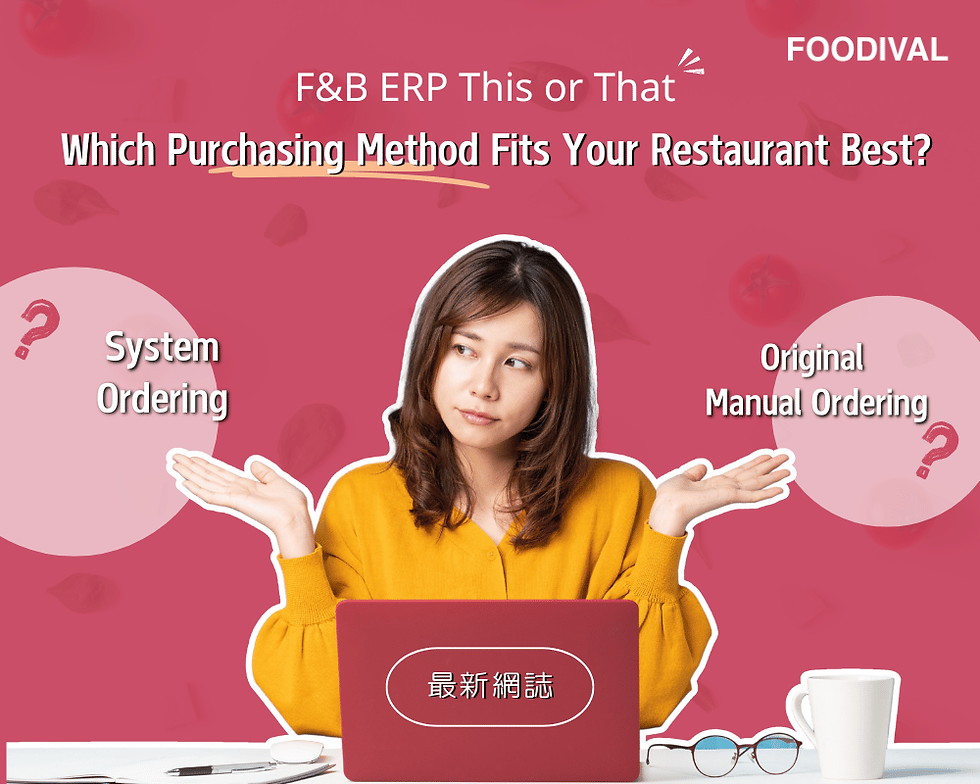
The market now offers an increasing number of restaurant purchasing systems. While many of them may appear similar in their offerings, they can create very different experiences for users in actual operation. As a result, many restaurant operators find it difficult to choose a system that truly fits their restaurants’ day-to-day operational needs and adopt the functions they require to accelerate efficiency.
This is especially true for operators with little system purchasing or implementation experience. They often focus too much on the price and overlook the practical values and benefits behind the system design, which means they may miss the opportunity to effectively improve efficiency and strengthen food cost control.
In this series, FOODIVAL will walk you through the key functions behind different restaurant systems and reveal the secrets behind each feature design while highlighting the important points to consider before making a purchase. With FOODIVAL, you are able to make a smarter choice with less hassle, increased revenues and lower costs!
System Breakdown: Centralised System Ordering vs. Manual Ordering via Multiple Channels
The purchasing methods are intimately linked to food cost control and overall operational efficiency. In fact, many FOODIVAL clients have shared the same doubt: “What happens if we place orders to suppliers without using a system? Will digitalisation increase our frontline workload and pressure?” It is undeniable that many operators move towards digitalisation with minimum disruption to their frontline for avoiding burnout at work.
The Difference Between System Ordering and Manual Ordering via Multiple Channels
System Ordering | Manual Ordering via Multiple Channels |
Accurate purchasing records with minimal manual operations and data integration work to enhance efficiency👍 | While minimizing intervention on frontlines, this approach is highly dependent on manual operations and prone to errors as the back office needs to record and integrate order details from branches |
Real-time back-and-front data synchronization which allows easy invoice reconciliation to identify discrepancies👍 | Lacking real-time data exchange between the front and backend systems, back office relies heavily on supplier invoices to settle payment, making it difficult to attain a truly automated invoice reconciliation |
Strengthened frontline and supplier management for better purchasing cost control👍 | unable to effectively monitor frontline's purchasing activities, resulting in weak cost control |
What are the Drawbacks of Manual Ordering via Multiple Channels by Different Restaurant Branches?
Take supplier ordering as an example. Many operators allow each outlet to place orders through different channels, such as phone calls, WhatsApp, email or fax, in the hope of making operations more convenient and less restrictive. This approach may seem more flexible and easier to manage to many. In reality, however, it can impose severe risks and may even increase the workload for both frontline and back-office teams due to extensive manual processing. For example, your teams have to spend more time on consolidating scattered information across multiple platforms. Inaccurate, untimely and missing records may lead to difficulty in timely purchase activity tracking and cost monitoring. It is also impossible for you to properly reconcile purchase orders with supplier invoices, forcing the team to rely solely on supplier invoices for payment settlement. As a result, purchasing records, cost accuracy, data flow and cost control capabilities are all weakened.
What are the Advantage of Centralised Ordering by System
On the contrary, when a restaurant places orders through a centralized system, every transaction is recorded clearly and every detail can be traced easily which significantly eliminates manual consolidation and entry work. This not only improves overall efficiency but also reduces the chances of errors. Moreover, you can enhance price negotiation and cost control with system ordering as the system can automatically compare suppliers’ offerings and identify the best deal with lowest price for you. Thus, you no longer have to spend additional efforts on comparing and tracing quotation details in order to save cost.
Another key advantage of system ordering is that data from the front and back office can be synchronised in real time, allowing management to keep track of each outlet’s purchasing activity and cost anytime. The system’s AI can also improve invoice reconciliation process by quickly identifying discrepancies such as overcharged amounts or undelivered items, making cost control and food inventory management easier than ever!
Does System Ordering Create Inconvenience to Restaurant Frontline?
As we can observe, many F&B clients still misunderstand what a system can do, assuming that digitalisation will only do more harm than good to their frontline . As a result, they choose to keep most processes manual, even if that means sacrificing data completeness and efficiency. In the end, many decisions can only be made based on staff experience, or even guesswork, which not only limits business growth but also makes it difficult to strengthen competitiveness or support long-term development.
In fact, as long as the system is designed to be practical and user-friendly, frontline staff can adopt it with ease without affecting their daily work. An effective and well-designed system can help simplify and automate complicated management processes, significantly improving overall efficiency. Of course, we understand that every restaurant operates differently, but FOODIVAL can flexibly adapt to your actual needs and help you find out the most suitable digital solution!
If you don’t want to make decisions based on guesswork anymore and hope to utilise data to support every step of your restaurant’s growth, don’t hesitate to contact FOODIVAL system consultants today to learn more!


Comments